The gospel of John has been described as a swinging pendulum. It starts in heaven:
“In the beginning was the Word, and the Word was God.”
Then it comes down,
“the Word became flesh and dwelt among us.”
The True Light coming down into our darkness. And, finally, we ascend with Jesus to Golgotha, the highest point in the world. the mountain on which humanity is reunited to God and we finally see the invisible God, made known to us in the Son lifted up on the cross.
Easter Sunday, the day of the resurrection, becomes the 8th day of the week, a new time, the inauguration of the Kingdom of heaven on earth. As Christians we always keep the end of this story in our hearts and minds: it’s the promise of every Sunday. We always pray to a living Jesus, seated at the right hand of God the Father, the one who has overcome the world. But today is Maundy Thursday. Today we are following our Lord down to the very bottom of all things, down into the depths of the lonely, naked, speechless humiliations of life.
According to the Gospel of John, the public ministry of Jesus begins at a wedding, one of life’s greatest celebrations. At the behest of his mother, Jesus reveals his power, his generosity, and his good plans; plans to prosper us and not to harm us. A loving son and a generous Creator, He gives abundantly (almost inordinately) the gift of wine, which is his first miracle. And through this gift, he affirms the goodness of human flourishing, of celebration, even the goodness of wine. The ministry of Jesus starts with celebration, and, by the end of chapter 2, “many believed in his name…’ ‘But,’ say the gospel ‘But Jesus on his part did not entrust himself to them, because he knew all people and needed no one to bear witness about man, for he himself knew what was in man.’ As Jesus continued his ministry, he constantly provoked a crisis of faith in those who encounter him. Some were offended by him, some followed him, but none understood him. By chapter 6, many of those who were following Jesus said, “This is a difficult way, who can follow it?” and they too began turning away. By the end of chapter 12 we are told that even those who remained with him ‘still did not believe in him.’
We can feel the pull of the downward swing in ourselves, can we not? The strength of our elders and our traditions fade with time. The brightest memories of our childhood are darkened by the experience of life. Maybe our parents once seemed infallible, maybe the Church was once a beacon of light to us, maybe our brothers and sisters, our friends were once constant and true. Maybe we used to believe that we were honest and hard-working people; sure of ourselves in our success and our Christian-humility. Maybe our own weddings were full of celebration and promise, holding all the possibility of getting it right.
After all, we were there, in the crowd on Palm Sunday, shouting “Hosanna! Long live the King!” We were there, anticipating the inauguration of God’s justice, celebrating the victory of goodness and truth over hatred and violence. We were looking forward to dressing in our best Sunday clothes and walking out into a bright Spring morning to usher in the age of righteousness. We were ready to be lifted up with Jesus into a new day of peace. We were ready for the upswing. Hosanna in the highest!” we shouted with the crowd. “Blessed is he who comes in the name of the Lord!”
But we didn’t understand where we were in the story, as we often don’t. Today is Maundy Thursday, and we are only now reaching the bottom.
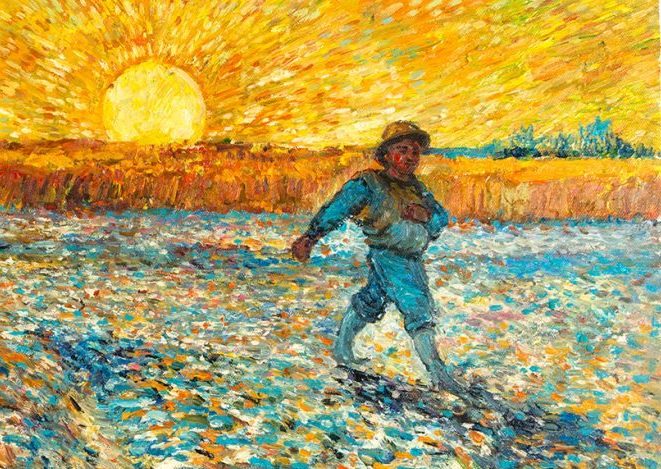
“Unless a grain of wheat falls into the earth and dies, it remains alone.” (John 12:24)
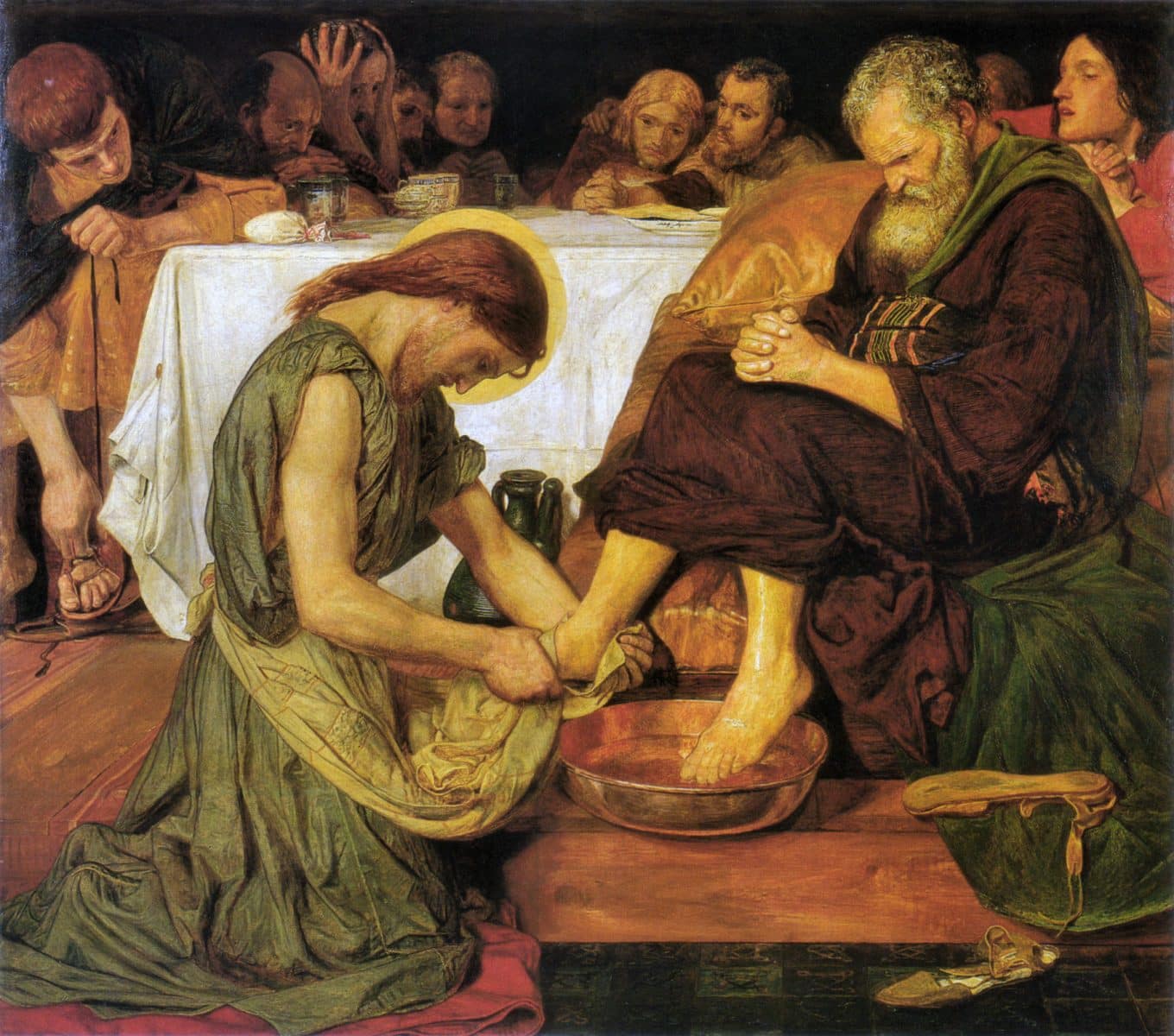
The ‘Hour of Glory,’ as it is sometimes called, does not begin in chapter 12 of John’s Gospel, with the Triumphal Entry of Palm Sunday. It begins in Chapter 13, when, as the Gospel reports, “Jesus knew that his hour had come to depart from this world and go to the Father.” Now we are approaching the very bottom of history, where The Way is abandoned, The Truth is silent, and The Life is sacrificed. And what is it that Jesus does in this moment? What does the Lord of History do here, at the turning point of all things? He washes the feet of his disciples. The One dressed in eternal light, strips his clothes and wraps himself in the towel of a servant; The One to whom every knee will bend, gets down on his knees and washes the dirty feet of his followers.
It is no wonder that Peter is offended, and says, “Lord you will never wash my feet.” It’s not what any of us want to see at the turning point of our history: dirty feet and a humiliated God. This is supposed to be the victory of God’s people over the world. The beginning of a new kingdom. Julius Caesar, when he was about to cross the Rubicon and change the shape of the world for ever, is reported to have said “alea iacta est”, “the die is cast.” Now that is a phrase worthy of history. That’s the confidence we look for in world changing leaders; an undaunted pride and self-assurance that we can follow into a ‘golden age.’
We don’t want to hear what the Prophet Isaiah said about our Lord and Teacher, that
“he had no form or majesty that we should look at him, and no beauty that we should desire him. He was despised and rejected by men, a man of sorrows and acquainted with grief; and as one from whom men hide their faces he was despised, and we esteemed him not.” (Is. 53)
When he washes the feet of his disciples, he forgoes even the dignity of speech. In humility he takes up the feet of Judas, knowing that Judas has already made up his mind to betrayed him. In humility he takes up the feet of Peter, knowing that Peter will soon deny him three times. ‘Surely not me Lord! You will never wash my feet! Surely the way up, the way of Life, is not a man down on his knees, naked, washing the dirty feet of traitors and unbelievers.’
And Jesus answered Peter, “Unless I wash you, you have no share with me.” The turning point of sacred history begins with foot washing. Somewhere between kneeling down to wash our feet, and rising up to face the cross, the Hour of our Lord’s Glory began. Tomorrow, Good Friday, we participate in Jesus’ trial, his inauguration and his crowing as the King. Tomorrow, we follow Jesus on the upward swing, up Golgotha, to the cross. But the hour of glory begins today, with Jesus taking off his garments, getting down on his knees, and washing the feet of his disciples. Even ours. In his humility he washes our feet, and in his authority he gives us a new commandment: “love one another. Just as I have loved you, you also should love one another.”
Every one of us wants to say, with Peter, ‘surely not I Lord. There is no need to wash my feet. ‘We keep our feet covered with shoes and socks. We invented indoor plumbing so we can wash our own feet in private. We paved our roads to keep the dirt off. We found an easier way, a better way. We automated foot-washing so that no one needs to stoop so low anymore. No need to wash our feet Lord.’
But as Jesus said to Peter on that Thursday night, so he says to us tonight,
“If I do not wash you, you have no share with me.”
Jesus did not come to invent the close-toed shoe, he did not introduce indoor plumbing to the world, he did not pave our roads. He washes our filthy feet, on his knees, with his own hands. And ‘when he had washed their feet and put on his outer garments and resumed his place, He said to them;
“Do you understand what I have done to you? You call me Teacher and Lord, and you are right, for so I am. If I then, your Lord and Teacher, have washed your feet, you also ought to wash one another’s feet.”
Today, at the crux of history, we gather to be washed by Christ, to participate in his humiliation and passion, his Hour of Glory. And we gather to hear, once again, the new commandment that he has given us, the ‘new way,’ in which he leads us. Down, down into the humble job of washing one another’s feet, even the feet of those who do not understand us, those who abandon us, and those who betray and deny us.
It’s not difficult for us to know what we are being called to do. Opportunities for our own humiliation and passion are never far from hand. It only takes a text message to invite your own Judas over for Easter dinner this Sunday. And how many Peters do we all have in our lives, waiting for us to come find them, and to ask them, ‘do you love me?’ How many Marys are in our lives, waiting for someone to tell them that their sins have been forgiven. How many Marys are in our lives waiting for someone to take them in as if they were their own mothers. Everyone of us has a Thomas in our lives who just needs to see our scars, in order to believe. There is no shortage of work to be done in the Church, no need to look far for an opportunity to love one another as Christ loved us. So take up your towel of humiliation and follow our Lord and Teacher down into the depths of human history, where God empties himself and takes on the form of the lowliest servant. Participate in the royal labor of Christ our King, and wash one another’s feet.
“The hour has come for the Son of Man to be glorified. Truly, truly, I say to you, unless a grain of wheat falls into the earth and dies, it remains alone; but if it dies, it bears much fruit.”
Amen

Holy Cross Anglican Church
Holy Cross is a new Anglican Church in Old Colorado City. We meet every Sunday morning to celebrate Holy Communion, share a meal, and spend time in conversation and learning.